
The Architectural Disruptor: Mapping Kanye West’s Global Sonic and Industrial Imprint
Tracing Ye’s global impact across music production, massive international stadium listening events, controversial political shockwaves, and the multi-billion-dollar Yeezy footwear ecosystem.
When Kanye West emerged from the production suites of Roc-A-Fella Records in the early 2000s, the recording industry viewed him strictly as an in-house beatmaker. Record executives doubted his viability as a solo star, citing his lack of street criminality narratives and his deliberate embrace of prep school attire, pastel polo shirts, and designer backpacks. Over the subsequent two decades, West completely dismantled those narrow commercial boundaries. Operating under the mononym Ye, he evolved from a Chicago soul-sampling producer into one of the most polarizing, economically disruptive cultural architects in modern history. His enterprise spans multi-platinum record catalogs, billionaire industrial design status, global political shockwaves, and avant-garde architectural stadium design.
The trajectory of his career represents an extraordinary study in cultural leverage and relentless creative disruption. West recognized early that true creative authority required complete ownership over both sonic composition and physical product manufacturing. Refusing to remain confined to the traditional role of a celebrity endorser, he forced multinational athletic conglomerates, legacy Parisian luxury houses, and international stadium operators to negotiate on his terms. His transition from an entertainment industry employee into an independent corporate principal redefined the commercial ceiling for hip-hop creators worldwide.
Analyzing the business architecture and design philosophy behind his enterprise reveals a complex ecosystem of sonic innovation, industrial scale, and public provocation. The Yeezy brand alone generated billions in annual retail revenues, transforming global athletic silhouettes and proving that an urban musician could command the same industrial authority as established footwear titans. Concurrently, his approach to live performance transformed traditional concert tours into immersive spatial art installations, drawing hundreds of thousands of international ticket buyers to synchronized stadium listening parties.
Understanding this global imprint requires evaluating four distinct pillars of his enterprise: his foundational sonic architecture across multiple musical eras, the multi-billion-dollar industrial footwear ecosystem, his spatial design approach to international stadium performances, and his complex political controversies that tested the outer boundaries of executive sovereignty.
Historically, recording artists remained confined within genre parameters dictated by legacy label executives.West rejected this categorization entirely, treating hip-hop not as a narrow musical genre, but as an expansive design methodology applicable to fashion, architecture, industrial manufacturing, and sacred choral music.
Sonic Architecture: Soul Samples, Vulnerability, and Production Camps
To appreciate his structural impact on modern culture, one must first analyze his radical sonic innovations.Prior to his solo arrival, mainstream rap was dominated by aggressive street anthems and synthetic keyboard arrangements. West introduced a dramatic sonic pivot by popularizing pitched-up vocal sampling, blending classic soul and rhythm-and-blues records with hard-hitting percussion to construct a warm, cinematic sound that dominated radio airwaves.
This early triumph laid the groundwork for an even more consequential sonic breakthrough. Following deep personal loss and romantic heartbreak, West abandoned conventional rap structures to create a minimalist,emotionally bare recording palette built around the Roland TR-808 drum machine and heavy auto-tune vocal processing. The project alienated traditional rap purists upon release, yet it birthed an entire generation of melodic, introspective superstars. The dominant sound of contemporary streaming platforms traces its lineage directly back to this specific sonic experiment.
Furthermore, his later albums integrated industrial noise, aggressive electronic synths, and classical choral arrangements. By collaborating with underground electronic producers, legendary rock instrumentalists, and classical conductors, he eliminated the artistic boundaries separating hip-hop from experimental avant-garde composition.
Beyond solo performance, West transformed the recording process itself into an institutional incubator.Pioneering large-scale creative summits in Hawaii, Wyoming, and Paris, he assembled elite coalitions of songwriters, instrumentalists, visual artists, and engineers to build albums through rigorous collective curation.This communal architecture elevated production standards across the recording industry, establishing a new model for artistic direction.
The Yeezy Industrial Ecosystem: Footwear Sovereignty and Design Scale
While his music catalog secured his artistic legacy, his foray into industrial design cemented his standing as a corporate founder. For decades, global sportswear giants relegated urban artists to passive promotional spokespersons, granting them flat endorsement checks to market existing sneaker models without offering design equity.
Following early creative capsule releases with Nike and Louis Vuitton, West executed a landmark corporate partnership with Adidas. Breaking industry precedent, West negotiated unprecedented creative autonomy and substantial backend royalties on every pair manufactured, fundamentally shifting the power dynamic between corporate capital and Black cultural creators. The resulting Yeezy footwear empire became a global retail phenomenon, generating over one billion dollars in annual sales and commanding massive secondary market resale premiums.
The design vocabulary of the Yeezy brand completely transformed the global footwear landscape. Introducing earth-toned palettes, minimalist knit slip-ons, and futuristic sculptural foam silhouettes, West forced competing athletic brands to abandon technical basketball sneakers in favor of comfort-focused lifestyle design. His footwear blurred the line between accessible streetwear and high-end sculpture.
Beyond footwear, West utilized his capital leverage to establish independent apparel factories and circular supply chains. His long-term ambition centered on democratizing luxury fashion through mass retail distribution. While several corporate distribution partnerships eventually dissolved amid intense public fallout,his operational footprint proved that cultural architects can command industrial supply chains at global scale.
Spatial Design and Live Performance: The Floating Stage and Stadium Listening
The evolution of his creative output extends deeply into architectural space and live performance engineering.West consistently challenged the commercial and physical limitations of traditional concert tours, collaborating with world-renowned stage designers to construct gravity-defying environments.
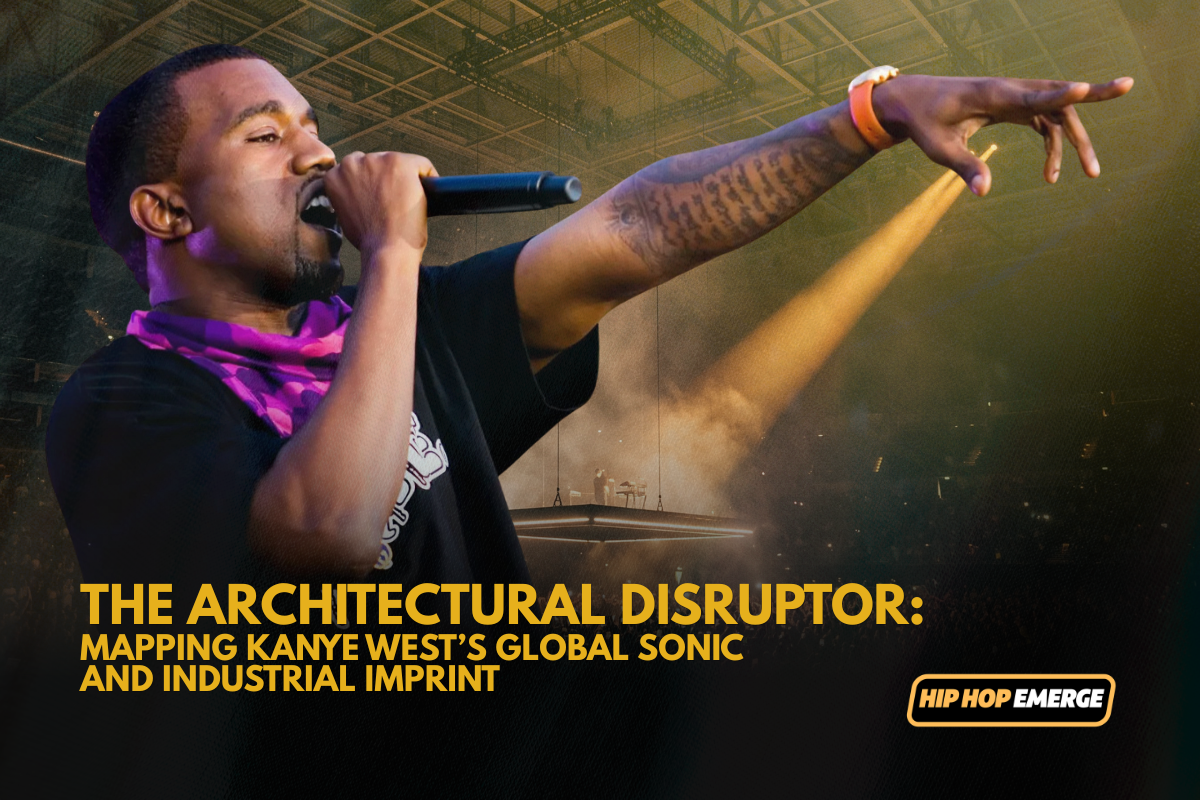
During his landmark arena tours, West introduced a kinetic floating stage suspended entirely by high-tension cables above the general admission floor. By elevating the performer above the audience, the design eliminated traditional physical barriers, allowing thousands of fans below to form a unified, moving mosh pit under the glowing stage. This radical spatial invention completely redefined the live stadium experience.
In recent years, West pioneered the stadium listening party format as a high-grossing commercial alternative to traditional live touring. Renting out massive sports stadiums in Atlanta, Chicago, Europe, and Asia, West sold out arenas merely to play unfinished audio files directly from digital workstations. These events featured monumental sculptural centerpieces, including full-scale replicas of his childhood home, minimalist dirt mounds, and military-style choreographies.
These stadium listening sessions proved that dedicated audiences would travel globally and purchase premium tickets simply to participate in an artist’s unfinished creative process. The format monetized unreleased intellectual property, generating tens of millions of dollars in single-night ticket and merchandise sales while bypassing standard promotional campaigns.
Political Shockwaves, Controversies, and Executive Autonomy
It is impossible to analyze his enterprise footprint without confronting the severe cultural shockwaves and public controversies that have defined his career. West operates without standard corporate public relations filters, utilizing his public platform to express controversial viewpoints on politics, historical trauma, and corporate control. His provocative statements and political alignments frequently resulted in swift public condemnation, canceled corporate alliances, and severed distribution contracts.
Yet, this polarizing public posture remains tied to his core business philosophy of absolute executive autonomy. His refusal to conform to corporate expectations reinforced his reputation among core supporters as an uncompromising creator who prioritizes personal sovereignty over corporate security. Even when stripped of major global distribution partners, his independent digital releases and direct-to-consumer product drops continued to generate millions in gross revenues, validating the economic power of direct fan loyalty.
The architectural legacy of Kanye West provides an essential case study in cultural sovereignty, institutional disruption, and creative ambition. He demonstrated that hip-hop creators possess the vision to reshape industrial design, live performance architecture, and modern music production. By challenging corporate boundaries and building independent design systems, Ye permanently altered the relationship between cultural creators and global capital.
SOURCES:
The Musical Evolution and Sonic Impact of Kanye West, Billboard Music History,
Inside the Multi-Billion-Dollar Yeezy Footwear Empire, Forbes Business Review,
The Architectural Stage Design of Kanye West Live Tours, Architectural Digest,
Stadium Listening Events and the New Economics of Live Music, Pollstar Industry Insights,