
Crossover Culture: How Allen Iverson Rewrote the NBA’s Aesthetic Mandate
An analysis of how Allen Iverson’s unapologetic authenticity brought hip-hop fashion, tattoos, cornrows, and streetwear directly into professional basketball, triggering David Stern’s 2005 dress code policy and permanently shifting athlete branding.
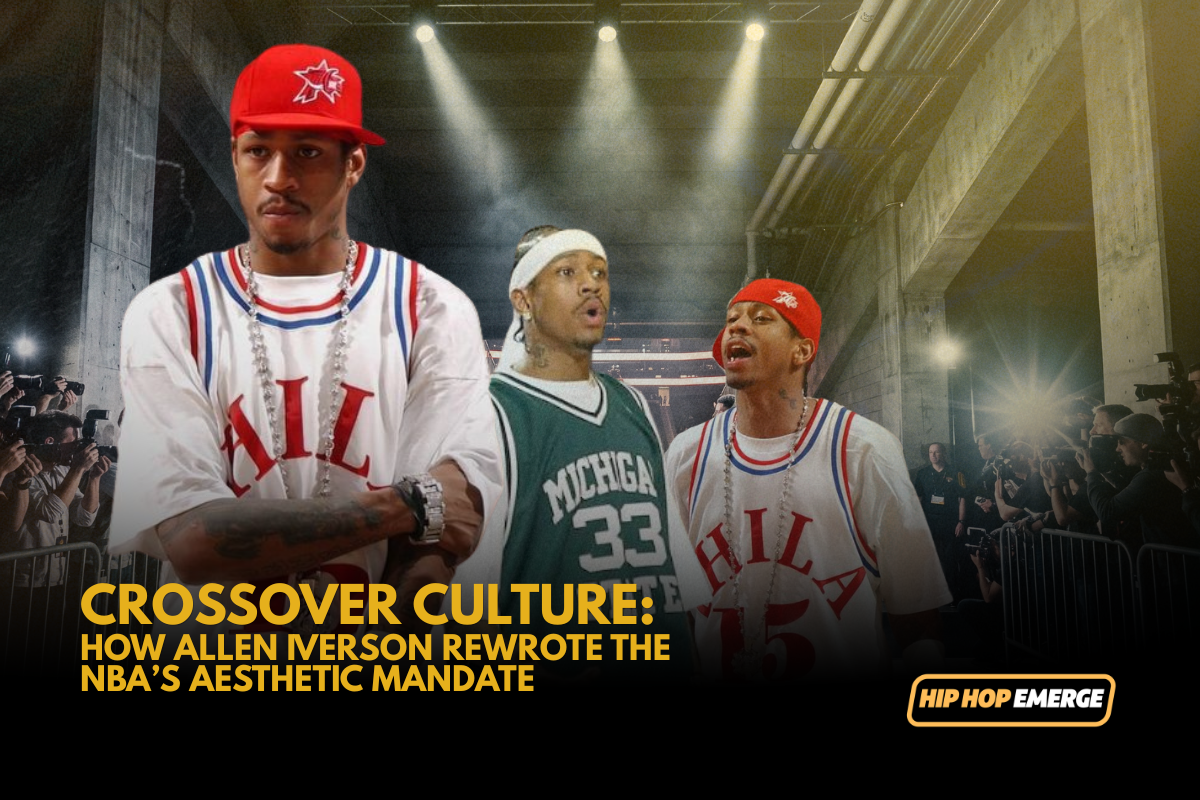
When Allen Iverson stepped onto the court as the first overall pick in the 1996 NBA Draft, he brought far more than a lethal crossover and relentless scoring drive. The Hampton, Virginia native arrived as an unfiltered avatar of urban youth culture, carrying the aesthetic language, attitude, and visual style of hip-hop directly into the corporate arenas of professional basketball. At a time when sports executives sought to market athletes through polished, pristine corporate personas, Iverson refused to separate his athletic identity from his cultural heritage. Through his cornrows, visible tattoos, arm sleeves, baggy jeans, and heavy jewelry, Iverson initiated a cultural collision that challenged the traditional boundaries of professional sports marketing.
Throughout the late 1990s and early 2000s, Iverson’s impact extended far beyond the Philadelphia 76ers roster. He became a global icon for a generation of fans who saw their own lives, fashion, and hip-hop sensibilities reflected on the highest stage of athletic competition. However, this authentic cultural alignment unsettled the NBA’s executive leadership. League officials and corporate sponsors worried that the growing influence of hip-hop aesthetics might alienate conservative corporate ticket buyers and television advertisers. The tension between authentic Black urban expression and corporate league control reached a breaking point in the mid-2000s.
On October 17, 2005, NBA Commissioner David Stern officially implemented a mandatory league-wide dress code. The strict policy required all players arriving or departing from scheduled games, sitting on the bench while injured, or conducting official league business to wear business casual attire, explicitly banning apparel associated with hip-hop style. While league executives framed the dress code as a necessary professional standard, players and cultural commentators recognized it as a direct mandate targeted at Iverson and the broader hip-hop generation.
Analyzing the aftermath of the 2005 dress code reveals an extraordinary paradox in cultural history. Rather than suppressing player individuality, Stern’s policy unintentionally sparked a high-fashion renaissance across professional sports. By forcing athletes to replace oversized streetwear with tailored wardrobe, Iverson’s ideological descendants converted arena arrival hallways into premier fashion runways, transforming NBA players into global style influencers and multi-million-dollar fashion directors.
Understanding Iverson’s legacy requires examining four critical strategic dimensions: the cultural friction of the late 1990s, the specifics and resistance surrounding the 2005 dress code, the birth of modern tunnel fashion, and the long-term commercial monetization of athlete identity.
The Cultural Collision: Hip-Hop Aesthetics Meets Corporate Sports
To evaluate Iverson’s transformative impact, one must examine the corporate culture of the NBA prior to his arrival. Following the global commercial peak of the 1990s, professional basketball marketing was heavily calibrated around clean-cut corporate spokespersons who maintained a carefully sanitized public image. Iverson completely dismantled this marketing paradigm by refusing to alter his appearance or speech for corporate approval.
First, Iverson brought hip-hop grooming and body art into mainstream sports media. His braided cornrows, executed with mathematical precision, replaced standard athletic haircuts, while his extensive tattoo collection told the story of his upbringing, personal loss, and neighborhood loyalty. What was initially vilified by conservative media outlets quickly became a global trend embraced by suburban youth and international athletes alike.
Second, Iverson redefined athletic footwear and streetwear alignment. His signature sneaker deal with Reebok, anchored by iconic silhouettes like the Question and the Answer, represented a departure from traditional performance basketball shoe campaigns. The advertisements featured hip-hop beats, street basketball courts, and raw urban storytelling, demonstrating that authentic culture could drive massive commercial footwear sales.
Third, Iverson normalized streetwear on the NBA sidelines. During press interviews, official travel, and bench appearances, Iverson wore oversized throwback jerseys, baggy denim, Timberland boots, durags, and heavy gold chains. This style was not a costume, but a direct extension of the fashion worn across Black communities in Philadelphia, New York, Atlanta, and Virginia.
Fourth, Iverson’s uncompromising authenticity established a new psychological model for Black professional athletes. He proved that an athlete could maintain total allegiance to their community roots while achieving MVP-level greatness, inspiring a generation of future stars to embrace their own personal expression.
The 2005 Mandate and the Battle for Cultural Authenticity
The tipping point for the NBA’s executive leadership occurred in the mid-2000s, accelerated by public relations challenges like the 2004 Malice at the Palace brawl in Detroit. Seeking to restore what it perceived as corporate professionalism to appealing to suburban sponsors, David Stern introduced the most restrictive dress code in modern sports history on November 1, 2005.
The 2005 dress code explicitly banned sleeveless shirts, shorts, T-shirts, oversized throwback jerseys, jeans, hats, durags, hiking boots, indoors sunglasses, and large chains or medallions worn over clothing. Players out of uniform sitting on the bench were required to wear a suit coat or sports jacket. Violators were subjected to escalating financial fines and game suspensions upon repeat offenses.
The reaction from players was swift and fiercely critical. Many athletes, led by Iverson, vocalized their opposition, pointing out that the policy targeted hip-hop culture and Black self-expression. Iverson famously noted that wearing a suit did not define a person’s character, famously asserting that you could put a bad person in a suit and they would still be the same individual underneath.
Critics across national media argued that the dress code imposed a restrictive white corporate standard on a league where over seventy-five percent of the players were Black. By policing clothing styles intimately tied to urban music, community identity, and youth culture, the league exposed a deep generational and racial divide between corporate team ownership and the athletes who generated the league’s revenue.
The Tunnel Fashion Revolution: From Mandate to Runway
While the 2005 dress code was designed to enforce corporate uniformity, its ultimate legacy was the exact opposite of what league executives intended. Rather than conforming to bland corporate suits, a new generation of players embraced the requirement for tailored wardrobe as an opportunity for high-fashion competition.
Led by style-conscious superstars like Dwyane Wade, LeBron James, Kobe Bryant, and Russell Westbrook, players hired personal stylists, collaborated with European luxury ateliers, and experimented with avant-garde tailoring. The pre-game walk from the team bus through the arena tunnel to the locker room evolved into the most influential runway in menswear fashion.
Camera crews and social media platforms began dedicating live coverage exclusively to pre-game arrivals. Fans and fashion editors analyzed player outfits with the same intensity as on-court performance metrics, turning arena tunnels into multi-million-dollar digital marketing stages.
Today, European luxury houses in Paris and Milan actively compete to dress NBA stars for tunnel walks. What began as a mandatory policy intended to suppress urban fashion inadvertently positioned NBA players as the premier tastemakers in global men’s fashion.
The Long-Term Economic Legacy of Athlete Self-Expression
The transformation triggered by Allen Iverson permanently altered the commercial economics of athlete branding and corporate partnerships. Modern athletes are no longer restricted to traditional sports equipment endorsements; they operate as multi-hyphenate creative directors, luxury brand ambassadors, and apparel entrepreneurs.
Current NBA stars command lucrative endorsement deals with global luxury houses, launch independent clothing lines, and sit front-row at Paris and Milan Fashion Weeks. The modern athlete’s ability to monetize their personal aesthetic and command high-margin apparel equity traces its origins directly back to Iverson’s refusal to compromise his identity.
Allen Iverson’s legacy is defined by cultural courage and uncompromising authenticity. By standing firm against corporate pressure and taking the brunt of institutional criticism, Iverson expanded the boundaries of cultural expression for every athlete who came after him. He proved that hip-hop culture is not a temporary trend to be managed, but an enduring global force that shapes popular culture, luxury fashion, and sports business worldwide.
SOURCES:
The NBA’s Dress Code Was Seen as Policing Black Culture. Instead It Inspired a Fashion Revolution, The Guardian,
NBA Dress Code Policy History and Details, Wikipedia,
NBA Dress Code: Image and Professionalism Analysis, Scribd Academic Archive,
The Impact of the NBA’s 2005 Dress Code Policy, The Triangle Offense,