
Sacred Ground: Why the First Hip-Hop School Belongs in the Bronx
Grounding formal hip-hop arts, music production, and history education in its geographical birthplace restores cultural stewardship to local youth and builds a permanent educational institution.
On August 11, 1973, in a modest recreation room at 1520 Sedgwick Avenue in the West Bronx, Clive “DJ Kool Herc” Campbell and his sister Cindy Campbell hosted a back-to-school jam that altered global culture forever. By isolating the percussion breaks on two turntables and extending the rhythm for dancers, Herc laid the sonic foundation for hip-hop. Over the subsequent five decades, the culture grew from a localized urban youth movement into a multi-billion-dollar global industry, shaping international fashion, global advertising, digital media, and fine art. Yet, despite generating immense corporate wealth worldwide, the neighborhood where the art form was forged historically lacked dedicated, accredited educational infrastructure to preserve its history and train its young creators.
The establishment of the Bronx School of Hip-Hop marks a monumental correction to this historic imbalance. Grounded directly in the geographical birthplace of the culture, the institution operates as a accredited educational sanctuary where middle school and high school students master the technical, artistic, and corporate disciplines of hip-hop. By integrating rigorous academic standards with hands-on technical training, the school restores cultural stewardship to the local community, ensuring that Bronx youth transition from passive consumers into sovereign owners of their creative heritage.
Unlike informal community centers or temporary after-school programs, the Bronx School of Hip-Hop embeds cultural education within a comprehensive public school curriculum. Students receive rigorous instruction across music engineering, digital audio workstation production, turntablism, vocal composition, visual arts, and dance, alongside essential business subjects including intellectual property law, publishing administration, and financial literacy. This holistic curriculum equips young creators with the tools required to navigate modern creative industries successfully.
Analyzing the launching of this institution reveals how cultural preservation and public education can unite to drive neighborhood revitalization. Examining the school’s structural blueprint offers essential lessons in geographical stewardship, coalition building, and economic pipeline development for urban youth.
Understanding the mission of the Bronx School of Hip-Hop requires evaluating three primary operational dimensions: the geographical significance of 1520 Sedgwick Avenue, the multi-disciplinary educational architecture, and the strategic coalition of pioneers, educators, and municipal leaders who built the institution.
Geographical Sovereignty: Preserving the Legacy of 1520 Sedgwick Avenue
To appreciate the cultural necessity of the school, one must understand why location is paramount in cultural preservation. For decades, institutions outside New York City extracted elements of hip-hop culture, commercialized them in distant markets, and failed to reinvest capital back into the South and West Bronx.
First, anchoring the school in the Bronx establishes permanent geographical sovereignty over hip-hop history. Students walk the same streets where DJ Kool Herc, Grandmaster Flash, Afrika Bambaataa, and the Cold Crush Brothers developed park jam sound systems, connecting daily academic studies with living local history.
Second, the institution serves as a physical archive for neighborhood artifacts, oral histories, and vintage recording equipment. Preserving early turntables, park jam cassette tapes, original graffiti sketchbooks, and flyer art inside a local educational institution prevents priceless cultural history from being lost or acquired exclusively by foreign private collectors.
Third, the school creates a direct economic pipeline for local Bronx families. Providing accessible technical training in music production, sound engineering, and media technology opens high-paying career pathways for local youth in a borough that has historically faced systemic economic disinvestment.
Fourth, local educational ownership fosters deep neighborhood pride. When young residents see their home borough recognized as an elite academic center of artistic excellence, it shifts public perception and strengthens community solidarity across generational lines.
Educational Architecture: The Four Elements and IP Literacy
The curriculum of the Bronx School of Hip-Hop is structured around the foundational four elements of the culture, paired directly with modern technical training and business education. This balanced approach guarantees that students graduate as both skilled artists and informed enterprise managers.
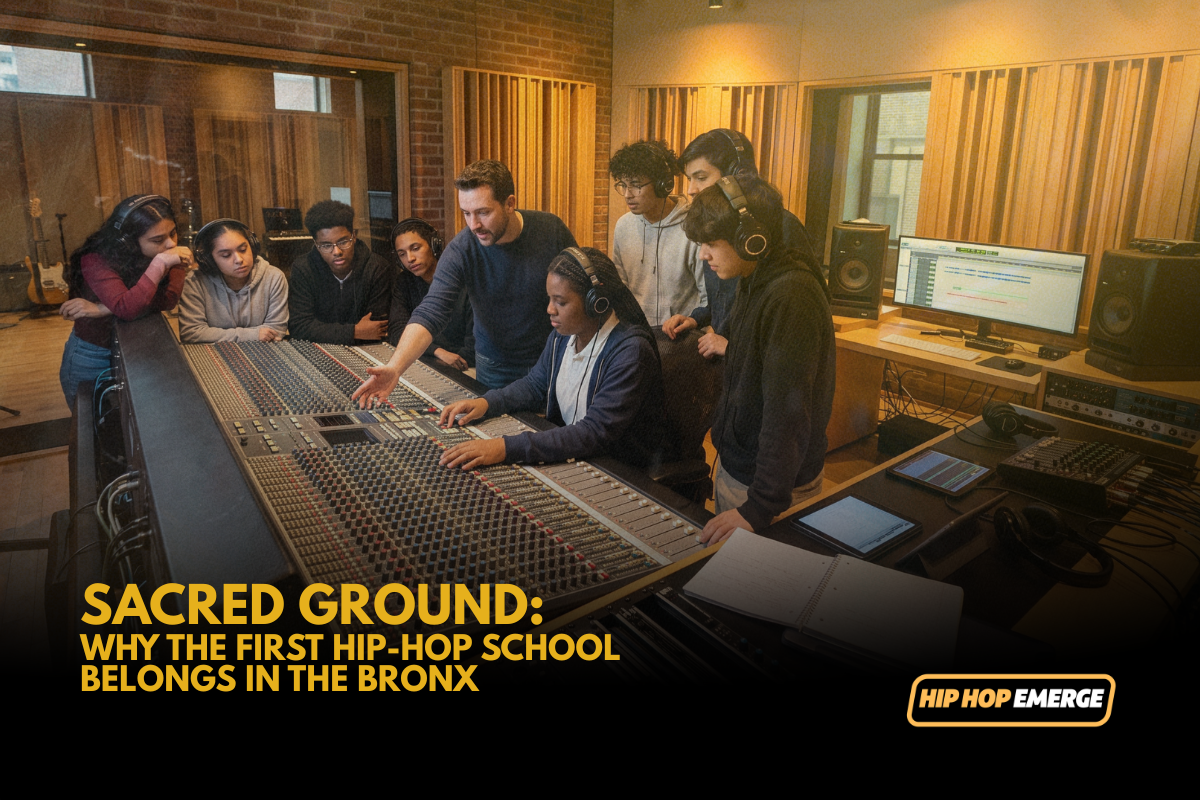
The DJing and Audio Engineering track teaches vinyl turntablism alongside modern digital audio workstations like Pro Tools and Ableton Live. Students master acoustics, audio mixing, mastering physics, and live sound reinforcement, preparing them for commercial recording studio careers.
The Lyricism and Composition track explores poetic structure, vocal breath control, songwriting architecture, and storytelling. In parallel, students analyze masterworks of American literature and historical speeches, contextualizing rap lyricism within a broader literary continuum.
The Breaking and Dance Studies curriculum provides physical training in breaking, popping, and locking, paired with kinesiology, dance notation, and choreography. The Visual Arts track teaches traditional mural art, graphic design, typography, and digital animation, transforming street art techniques into commercial design skills.
Crucially, all students participate in mandatory courses on Intellectual Property and Financial Literacy. Learning how copyright registration, publishing splits, trademark protection, and master ownership work ensures that graduates protect their creative work and build lasting equity.
A Coalition of Pioneers, Educators, and Municipal Leadership
The realization of the Bronx School of Hip-Hop was made possible through an unprecedented coalition uniting hip-hop pioneers, local educators, community activists, and municipal government officials. Recognizing that authentic cultural education requires living masters, the school integrates veteran artists directly into classroom instruction.
Pioneering DJs, MCs, legendary graffiti writers, and world-champion breaking pioneers serve as master instructors and artists-in-residence. Working alongside licensed public school educators, these cultural elders pass down oral traditions, technical nuances, and professional ethics directly to the next generation.
Furthermore, municipal leaders and the New York City Department of Education provided essential capital funding, facility support, and official accreditation. High-level sit-downs between civic leaders and prominent rap icons ensured that municipal policy aligned with the community’s vision for cultural preservation.
Local community organizations, youth advocates, and non-profit funds also contributed equipment donations, studio construction grants, and internship placement pipelines. This multi-sector alignment proves that public-private partnerships can successfully build institutions that serve local neighborhood interests.
Restoring Stewardship for Generations to Come
The opening of the Bronx School of Hip-Hop represents far more than an educational milestone; it stands as a victory for cultural autonomy and civic equity. By establishing an accredited sanctuary where hip-hop history and industry skills are formally taught at the birthplace of the art form, the Bronx reclaims its rightful role as the spiritual capital of urban culture.
For educational leaders and cultural advocates globally, the Bronx School of Hip-Hop offers an inspiring operational template. True cultural respect requires building permanent institutions, funding technical education, and entrusting local communities with the stewardship of their own heritage.
As hip-hop continues to shape world fashion, digital media, and global music, the young creators graduating from the Bronx will stand at the forefront of the industry. Equipped with artistic mastery, technical capability, and enterprise literacy, they ensure that the sacred ground of the Bronx will continue to nourish global culture for generations to come.
SOURCES:
1520 Sedgwick Avenue: Birthplace of Hip Hop History and Cultural Recognition, National Park Service Archive,
Universal Hip Hop Museum and Educational Programming in the Bronx, Universal Hip Hop Museum Official Portal,
NYC Department of Education High School Arts & Technology Pipelines, New York City Public Schools,
Hip Hop Education Center and Culturally Responsive Pedagogy, Hip Hop Ed,